Showing posts with label Python. Show all posts

11 November 2018

Widespread Architectural Changes using IDEs

This is the second part of my list of tools to automate Widespread Architectural Changes. Now Widespread Architectural Change is a category of architectural refactoring which do not change the overall structure but need to be applied in many places consistently across a whole code base. For example, consider changing or unifying coding conventions or fixing violations. The main challenge of these changes is the high number of occurrences.

The goal of this article is to introduce you to ways to automate such changes. I have been using some of these techniques because as Code Cop I value code consistency, still this is a raw list. I have only used a few of the mentioned tools and need to explore many in more detail.

In the first part I listed some basic options, e.g. how to support manual changes with fast navigation, search and replace across the whole file system, use scripted search and replace using regular expressions, Macros and finally JetBrains' Structural Search and Replace. This time I focus on options available for modern IDEs. Tools like Eclipse or IntelliJ use an internal representation of the code, the Abstract Syntax Tree (AST). Structural Search and Replace works the AST and therefore belongs into this group as well.

Rescripter (Eclipse)
Modern IDEs support many Refactoring steps - why not use the existing tools to make our job easier? One of such tools is Rescripter, built for making large-scale changes that you can describe easily but are laborious to do by hand. Rescripter is an Eclipse plugin which runs JavaScript in the context of the Eclipse JDT. David Green added some helper objects to make searching, parsing and modifying Java code easier and wrapped a thin JavaScript layer around it. Rescripter scripts are working the AST.

Here are two examples from Rescripter's documentation: Finding a method named getName inside the class Person:
var type = Find.typeByName("Person");
var method = Find.methodByName(type, "getName").getElementName();
and adding a method getJobTitle to that type:
var edit = new SourceChange(type.getCompilationUnit());
edit.addEdit(ChangeType.addMethod(type, "\n\tpublic String getJobTitle() {\n" +
                                        "\t\treturn this.jobTitle;\n" +
                                        "\t}"));
edit.apply();
Rescripter is an old project and has not been updated since 2011. While it has some demo code and documentation, it is a bit raw. I guess it is not compatible with newer versions of Eclipse. Still - like Structural Search and Replace - it is very powerful. If you have a large code base and a repetitive change that can be expressed in terms of the AST, the high effort to get into the tool and create a script will pay off. (A useful plugin to help you working the AST is the AST View. The AST View is part of the JDT but not installed out of the box. It is visualising the AST of a Java file open in the editor.)

JackpotJackpot (NetBeans)
Another, very interesting tool in this area is the Jackpot DSL for NetBeans used in the IDE actions Inspect and Transform aka Inspect and Refactor. Jackpot is a NetBeans IDE module for modelling, querying and transforming Java source files. In the Jackpot context, a program transformation is a script or Java class which queries sources in Java projects for patterns, changes them, and then writes these changes back to the original source files. [...] Jackpot transformations tend to be applied globally, such as at a project level or across several projects. Win! Unfortunately there is very little information about it. It took me hours just to find a little bit of information about it:

Dustin Marx describes how to create NetBeans 7.1 custom hints. He agrees that the most difficult aspect of using NetBeans's custom hints is finding documentation on how to use them. The best sources currently available appear to be the NetBeans 7.1 Release Notes, several Wielenga posts (Custom Declarative Hints in NetBeans IDE 7.1, Oh No Vector!, Oh No @Override!), and Jan Lahoda's jackpot30 Rules Language (covers the rules language syntax used by the custom inspections/hints). The Refactoring with Inspect and Transform in the NetBeans IDE Java Editor tutorial also includes a section on managing custom hints. All listed documentation is from 2011/2012. The most recent one I found is a short Jackpot demo from JavaOne Brazil 2016.

NetBeans hints are warnings that have a quick fix. For example the hint "Can Use Diamond" finds places where the diamond operator of Java 7 can be used instead of explicit type parameters. When the offered action is taken, the code is migrated. In the Inspect and Transform dialogue, the inspections can be managed. Custom hints are stored in .hint files. For example, Dustin Marx' hint to remove extraneous calls to System.currentTimeMillis() from new java.util.Date constructor is written as
<!description="Unnecessary use of System.currentTimeMillis on new Date">

new java.util.Date(java.lang.System.currentTimeMillis())
=> new java.util.Date()
;;
The Java Declarative Hints Format allows matching on variables, modifiers and statements. Fixes can be applied conditionally too.

I do not know if Jackpot hints can be applied across a whole code base at once. As they are inspections, I expect them to be displayed for the whole project - making them fast navigation markers at least. Anyway this is very exciting. It is so exciting that some people wanted to port it to Eclipse (but they never did).

Using Specific Refactoring Plugins
There are a few specific plugins that combine various Refactoring. Eclipse's Source Clean Up Action deserves a honorary mention: It fixes basic warnings on a whole code base, but is very limited. An interesting plugin for Eclipse is Autorefactor which aims to fix language/API usage to deliver smaller, more maintainable and more expressive code bases. Spartan Refactoring is another Eclipse plugin that performs automatic refactoring of Java source code, making it shorter, more idiomatic and more readable.

All these plugins change a predefined, limited set of code patterns, mainly focusing on technical debt. Maybe someone implemented a refactoring plugin for part of the widespread change you need to perform. Search the market places first.

Using Refactoring APIs of IDEs
A possible way is to write your own refactoring plugin. Maybe start with code of a refactoring plugin listed above. Both Eclipse and IntelliJ IDEA offer APIs to manipulating Java code, i.e. the JDT and PSI APIs. I have not done that because it seems too much effort for one time migrations and widespread changes. And reusing the available refactoring tools might raise some problems like waiting for user input which is problematic.

Using (APIs of) Refactoring Browsers
The Refactoring Browser was the first tool that automated Refactoring for Smalltalk. It set the standard for all modern Refactoring tools. Today we have Refactoring Browsers for many languages, e.g. CScout - the C Refactoring Browser, Ruby Refactoring Browser for Emacs or PHP Refactoring Browser which is controlled via the command-line and has plugins for Vim and Emacs. Stand-alone Refactoring tools should be easier to use and script than full blown IDEs, especially if they were designed for different plugins. The idea would be to create code which controls Refactoring Browsers to apply certain changes - again and again.

RopePython Refactoring Libraries
While searching for Refactoring Browsers I just learnt that there are at least three stand-alone Python Refactoring libraries: Rope comes with Vim and Emacs plugins and is also used in VS Code. The second is Bicycle Repair Man. Further there is Bowler which supposedly is better suited for use from the command-line and encourages scripting. All these libraries are rich in features and used by Vim users. (Yeah, Vim is still going strong.)

Rope (Python)
For example, Rope can be used as a library, which allows custom refactoring steps. Even more, it offers something similar to Jackpot's hints, Restructurings. For example, we split a method f(self, p1, p2) of a class mod.A into f1(self, p1) and f2(self, p2). The following Restructuring updates all call sites:
pattern: ${inst}.f(${p1}, ${p2})
goal:
 ${inst}.f1(${p1})
 ${inst}.f2(${p2})

args:
 inst: type=mod.A
The code to perform the Restructuring using Rope as a library is
from rope.base.project import Project
from rope.refactor import restructure

project = Project('.')

pattern = '${inst}.f(${p1}, ${p2})'
goal = '...'
args = '...'

restructuring = restructure.Restructure(project, pattern, goal, args)

project.do(restructuring.get_changes())
I never used that but it looks cool. The promise of scripted refactoring makes me excited. Another item to add to my to-research list. ;-) And there are more tools on my list, which will have to wait for part 3.
29 June 2018

xUnit Testing Koans Reloaded

Koans are sequences of little exercises to help you "on your way to enlightenment". Testing Koans are similar exercises to help you learn unit testing. Usually the code is in place, but the assertions are missing. xUnit Koans are Testing Koans for SUnit inspired testing frameworks, like JUnit, minitest, NUnit, PHPUnit, xUnit.net and more. They are introductory exercises which cover the most basic usage of assertions and life cycle methods.

JUnit5 Koans RetrospectiveJUnit 4 and PHPUnit
Initially I created a few JUnit Testing Koans in 2012 as part of a JUnit training while I was with IBM. I wanted the training to be hands-on and interactive. (These koans are in the Unit Testing Koans repository.) In 2015 I picked up the idea and ported the code to PHP to run a PHPUnit workshop for my local community. (These koans are in the same repository.)

JUnit 5
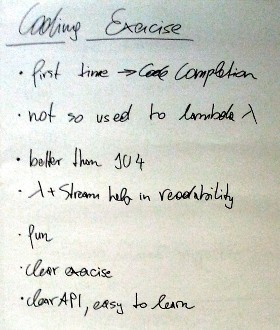
In 2017, with the new version of JUnit, Görge Albrecht, the Code Mentor, helped me add koans for new features of JUnit 5. We used the koans as hands-on exercises which were a part of our JUnit 5 introductory workshop, delivered at Topconf Linz 2017 and other conferences. The exercises worked well and gave an overview of the (old and) new API and showed how to use it. People liked the workshop and had fun, see the points made during the retrospective of one of the workshops on the right. (The code is in the same repository.)

Python's unittest
It seems that the koans keep coming back to me ;-) - and I keep coming back to them, always adding more exercises and languages. This year I ported them to Python, which took me around five hours. I ran them as a short, Pragmatic Introduction to Python Unit Testing at PyDays 2018. I liked PyDays for its enthusiastic crowd and consider the workshop successful because in the final feedback round several participants reported happily that they had "written their first test" and that "it's not that hard!". Even experienced participants reported some learnings, like "I never used skip" or "I did not know how to check the message in asserting exceptions". (The latest and greatest koans are in the same repository.)

Teaching xUnit
Koans, i.e. learning progress verification by assertions, work well in both static and dynamic languages. There is no difference in workshops using Java and PHP or Python. Testing Koans are a suitable exercise to help people with their first steps in unit testing. In short two hours, people who have never seen a test will learn the concepts and flow of unit testing. I usually start with a few slides, about 20 minutes of theory about structure of xUnit tests before I ask people to work with the exercises.

JUnit5 handouts by GörgeLike with JUnit 5, Testing Koans also work well to introduce people to new testing framework APIs and their usage. People familiar with JUnit 4 will need no more than a migration guide, see Görge's handouts on the right, to get their first impression of the new features. Some more advanced aspects will require them to research the documentation, but that is part of the exercise.



People appreciate the "focused, step by step nature" of koans. The "exercise is clear" and "invites to explore xUnit". And most importantly "it was fun". In all the feedback I have collected for my xUnit Testing Koans, fun is dominant. And fun helps learning. (All quotes were taken as is from actual feedback I got.)

Moar Testing Koans!
Most xUnit frameworks are consistent with xUnit, and are similar in their usage. It is easy to port the koans to other languages, at least for basic examples. The same is true for newer versions. I should upgrade some koans to accommodate newer features of the used frameworks, on the other hand the basic features are still the same. I would love to see more ports and also Koans for different testing styles, e.g. RSpec or Jasmine Testing Koans.

Current List of Koans

16 August 2016

Absolute Priority Premise, an Example

Optimus Prime, Transformers ToysTransformation Priority Premise
I would like to start this article with Uncle Bob Martin's Transformation Priority Premise - TPP for short - which he defined in 2011. With the premise Uncle Bob gave an algorithm how to find the next test when doing Test Driven Development. During (classic) TDD we use transformations to change the code to get from red to green. For example when starting with a new method the very first test is usually red because the empty or generated method returns null. We fake the first test by changing that null to return a constant value, e.g. return 5. This transformation is called nil->constant and has a high priority. A later test might force us to add a conditional to enable another fake. This transformation is called unconditional->if and has a medium priority. Replacing the value of a variable, i.e. variable->assignment has a low priority.

According to Uncle Bob, these transformations have a preferred ordering. We should prefer higher priority transformations to pass tests and chose tests in a way that they can be passed with higher priority transformations. When an implementation seems to require a low priority transformation, we could backtrack to see if there is another test to pass first which does not need that transformation. The theme behind the TPP is that as the tests get more specific, the code gets more generic. If you want to know more about TPP, see Uncle Bob's cartoon follow-up on the TPP and Sorting and his talk on the Transformation Priority Premise.

Absolute Priority Premise
In 2012 Micah Martin set out to define some heuristics to compare code objectively and proof that some code is better than some other code. Building on the TPP's priorities he defined the Absolute Priority Premise - APP for short. The APP knows six components, i.e. basic building blocks of code, and assigns them a mass. The building blocks and their weights were
  • constant, a value in code has mass of 1.
  • binding, a name or variable has a mass of 1, too.
  • invocation, calling a method or function - mass 2.
  • conditional, any form of if, switch or case - mass 4.
  • loop, for or while loops - mass 5.
  • assignment, replacing the value of a variable - mass 6.
More complex building blocks have a higher mass. The total mass of a piece of code is the sum of the mass of its respective components. A lower value is better. The best set of specific values of mass are unknown and I will use Micah's weights. If you chose to count different, please let us discuss!

A detailed explanation of the Absolute Priority Premise is given in the two presentations of 8th Light University (8LU) - Part One and Part Two. See also Micah's Coin Changer Kata as a complete example of applying the premise.

Measuring the Mass of Code
I like Micah's idea to measure the mass of code. It might not be a direct indication of readability but simpler code is always better. I wrote six different versions of the Word Wrap kata and was wondering which one would be considered the "best". I should have calculated the mass of these algorithms manually, but I followed Terence Parr's advice, to avoid working by hand five days what I can spend five years of my life automating. I had to create a tool to calculate the mass of Java code - which of course took me much longer, especially as I verified the mass of each algorithm manually to make sure my code worked as expected.

Absolute Priority Counter
I created abpricou, the ABsolute PRIority COUnter. It parses Java source and collects its mass as defined by the Absolute Priority Premise. It is written in Python, because it was Python month when I started working on it. It uses the Python Java Parser plyj. plyj offers a Visitor API for parser events,
class CountingVisitor(m.Visitor):
    def __init__(self):
        super(CountingVisitor, self).__init__()
        ...
Constants and bindings are staight forward, e.g.
    def visit_Literal(self, literal):
        return self._a_constant_value()

    def visit_FormalParameter(self, parameter):
        return self._a_name()
Literals in the code are counted as constants and parameters are only names for values, thus bindings. A method or function counts as a constant for the code it represents and a binding for its name.
    def visit_MethodDeclaration(self, declaration):
        self._a_name()
        return self._code_is_a_constant()
Invocations, conditionals and loops are the same. For example
    def visit_MethodInvocation(self, invocation):
        return self._an_invocation()

    def visit_IfThenElse(self, conditional):
        return self._a_conditional()

    def visit_While(self, loop):
        return self._a_loop()
The only interesting case is the assignment. Not every assignment in Java is counted as an assignment, only re-assignments which modify values are counted. final fields or local variables are just names for expressions similar to parameters.
    def visit_Assignment(self, assignment):
        if ... :
            # code to ignore
            # final field is assigned in constructor
            # final local is assigned in block
        else:
            return self._an_assignment()
Get the tarball and installable egg of the Absolute Priority Counter.

Let's see some code: Word Wrap Kata
As I said before, I developed the counter to calculate the mass of my different implementations of Word Wrap. I was interested in the mass of the algorithm and skipped constructs like class definitions. (I suppose a class definition is a constant for the code and a binding for the name.) I also ignored Annotations, Enumerations and Generics. The first algorithm uses recursion to loop over the blanks to find the end of each line. Its code is
   final char BLANK = ' ';
   final char NEWLINE = '\n';

   String wrapRecursive(String line, int maxLineLen) {
      if (line.length() <= maxLineLen) {
         return line;
      }

      int indexOfBlank = line.lastIndexOf(BLANK, maxLineLen);
      int split;
      int offset;
      if (indexOfBlank > -1) {
         split = indexOfBlank;
         offset = 1;
      } else {
         split = maxLineLen;
         offset = 0;
      }
      return line.substring(0, split) + NEWLINE
           + wrap(line.substring(split + offset), maxLineLen);
  }
including the components
| Component   | Mass  | Count |
| constant    |   1   |   7   |
| binding     |   1   |   8   |
| invocation  |   3   |  10   |
| conditional |   4   |   2   |
| loop        |   5   |   0   |
| assignment  |   6   |   0   |
resulting in a total mass of 53. Further implementations have the following masses:Scales
  • The tail recursive solution has neither loops nor assignments similar to the recursive one and has a total mass of 71. (The source of this and all further variants is given in Word Wrap Kata Variants.)
  • The looping variant contains a loop and an assignment resulting in a mass of 68.
  • The optimised loop which avoids temporary String objects, contains a loop and an assignment and some more invocations. Its mass is 80.
  • The loop using a buffer saves even more heap allocations and needs more invocations summing up to 105.
  • The solution using Regular Expressions as shown in the original article has a mass of 55. Merging the parts of the expression into a single expression would save five invocations, but makes the expression less readable. I argue that the Regular Expression itself has some weight, as it contains one conditional ("|" in line 3) and two loops ("(.{1," + maxLineLen + "})" in lines 1 and 4). So a fair weight is 69.
  • The functional version using flatMap and reduce is quite verbose due the lack of inferred pair types in Java. As plyj does not support Java 8 I was unable to measure its mass.
First Conclusion on Algorithms
The most basic, recursive version of Word Wrap has the least weight. What does it mean? Is it the best version? It is the most compact version without playing Code golf, at least in Java. It does not mutate any variables but it puts the highest load on the Garbage Collector. All the discussed algorithms have different memory and run time performance characteristics. I had hoped for a clear answer what the best version would be and I am not seeing that. I challenge you to leave a comment with a version of Word Wrap with a smaller weight. Would it be considered better code?

The mass of the basic loop version seems too much compared to the recursive version. The current weights favour functional programming by putting a penalty on loops and assignments. Mutating a local variable has a smaller weight than mutating the state of an object. The looping version uses StringBuilder instead of plain String + which needs two more invocations for its construction. Then its components are
| Component        | Mass  | Count |
| constant         |   1   |   8   |
| binding          |   1   |  10   |
| local assignment |   1   |   3   | like a new local binding
| invocation       |   3   |  10   |
| conditional      |   4   |   1   |
| loop             |   5   |   1   |
| assignment       |   6   |   0   |
and its mass is 60 which is a bit more code than the recursive solution.

More Structure
The different wrap() functions above are just algorithms. They are not factored into parts that might change at different speeds over time and definitely violate the SRP. They also break the OCP as it is impossible to change the strategy of splitting without touching the logic of collecting. To address this I wrote another recursive version following Tell, don't ask,
interface Page {
   void renderLine(String lineOfProperLength);
}

class Wrapper {

   final char BLANK = ' ';

   final Page page;
   final int maxLineLen;

   Wrapper(Page page, int maxLineLen) {
      this.page = page;
      this.maxLineLen = maxLineLen;
   }

   void wrap(String line) {
      if (line.length() <= maxLineLen) {
         page.renderLine(line);
         return;
      }

      int indexOfBlank = line.lastIndexOf(BLANK, maxLineLen);
      int split;
      int offset;
      if (indexOfBlank > -1) {
         split = indexOfBlank;
         offset = 1;
      } else {
         split = maxLineLen;
         offset = 0;
      }

      page.renderLine(line.substring(0, split));
      wrap(line.substring(split + offset));
   }
}
which is very similar to the tail recursive solution above, with a total weight of 56. The number is smaller because it does not contain the necessary implementation of Page.renderLine(). The shown code does less, which makes it difficult to compare. On the other hand Page.renderLine() might be used by other parts of the code as well, so it is not strictly a part of Word Wrap.

Moar Structure!1!!
Later I created an extremely factored and decomposed implementation of Word Wrap that separated concepts of rendering, splitting, accumulating lines and hyphenation rules which should fulfil both SRP and OCP. Ignoring the HyphenationRule because that is not covered by the other solutions, its mass is 167 due to many method invocations and parameter names:
| Component   | Mass  | Count |
| constant    |   1   |  17   |
| binding     |   1   |  33   |
| invocation  |   3   |  30   |
| conditional |   4   |   4   |
| loop        |   5   |   1   |
| assignment  |   6   |   1   |
There is a loop and an assignment, at its core this implementation is a looping one. Using the recursive solution I should be able to get rid of the loop and the assignment.

Conclusion
The Absolute Priority Premise counts the different components of a program and sums their weights. If the weights are correct than the program with the smallest mass would be considered the "best" program. This is not true for algorithms like the Word Wrap because the APP ignores features like memory usage or performance optimisation. For general purpose code the validity of the APP is unclear. It just measures the number of code constructs, favouring more compact, functional code. On the other hand the four rules of simple design encourage us to introduce explaining variables to reveal the intent of the code which is more important than fewer elements.