Showing posts with label NATURAL. Show all posts

7 January 2020

Visualising Architecture: GraphML Charting Module Dependencies

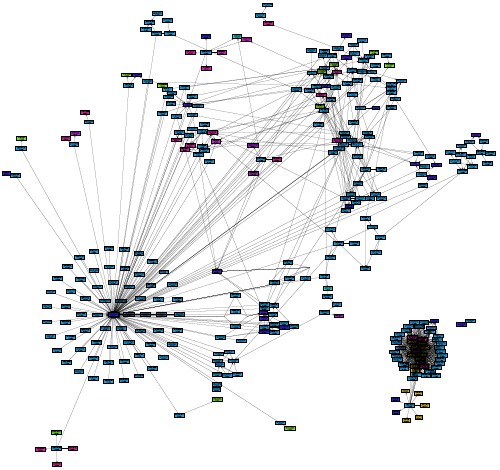
When working with existing code, analysing module dependencies helps me understand the bigger picture. For well defined modules like Eclipse OSGi or Maven there are tools to show all modules and their inter dependencies, e.g. the Eclipse Dependency Visualization tool or the Maven Module Dependency Graph Creator. For legacy technologies like COBOL and NATURAL - and probably some more platforms - we struggle due to the lack of such tools. Then the best approach is to extract the necessary information and put it into a modern, well known format. I wrote about such an approach in the past, e.g. loading references from a CSV into Neo4j for easy navigation and visualization. Today I want to sketch another idea I have used since many years: Using GraphML to chart module dependencies. For example, the following graph shows the (filtered) modules of a NATURAL application together with their dependencies in an organic layout.

Some modules of a NATURAL application in an organic layout, 2017
Process
GraphML is an XML-based file format for graphs. [...] It uses an XML-based syntax and supports the entire range of possible graph structure constellations including directed, undirected, mixed graphs, hyper graphs, and application-specific attributes. That should be more than enough to visualize any module dependencies. In fact I just need nodes and edges. My process to use GraphML is always the same:
  1. Start with defining or extracting the modules and their dependencies.
  2. Create a little script which loads the extracted data and creates a raw GraphML XML file.
  3. Use an existing graph editor to tweak and layout the diagram.
  4. Export the the diagram as PDF or as image.
Get the raw data
Extracting the module information is highly programming language specific. For Java I used my JavaClass class file parser. For NATURAL I used a CSV of all references which was provided by my client. Usually regular expressions work well to parse import, using or include statements. For example to analyse plain C, scan for #include statements (as done in Schmidrules for Application Architecture. Unfortunately there is not much documentation available about Schmidrules, which I will fix in the future.)

Create the XML
The next task is to create the XML. I use a little Ruby script to serializes a graph of nodes into GraphML. The used Node class needs a name and a list of dependencies, which are Nodes again. save stores the graph as GraphML.
require 'rexml/document'

class GraphmlSerializer
  include REXML

  # Save the _graph_ to _filename_ .
  def save(filename, graph)
    File.open(filename + '.graphml', 'w') do |f|
      doc = graph_to_xml(graph)
      doc.write(out_string = '<?xml version="1.0" encoding="UTF-8" standalone="no"?>')
      f.print out_string
    end
  end

  # Return an XML document of the GraphML serialized _graph_ .
  def graph_to_xml(graph)
    doc = create_xml_doc
    container = add_graph_element(doc)
    graph.to_a.each { |node| add_node_as_xml(container, node) }
    doc
  end

  private

  def create_xml_doc
    REXML::Document.new
  end

  def add_graph_element(doc)
    root = doc.add_element('graphml',
      'xmlns' => 'http://graphml.graphdrawing.org/xmlns',
      'xmlns:y' => 'http://www.yworks.com/xml/graphml',
      'xmlns:xsi' => 'http://www.w3.org/2001/XMLSchema-instance',
      'xsi:schemaLocation' => 'http://graphml.graphdrawing.org/xmlns http://www.yworks.com/xml/schema/graphml/1.1/ygraphml.xsd')
    root.add_element('key', 'id' => 'n1',
                     'for' => 'node',
                     'yfiles.type' => 'nodegraphics')
    root.add_element('key', 'id' => 'e1',
                     'for' => 'edge',
                     'yfiles.type' => 'edgegraphics')

    root.add_element('graph', 'edgedefault' => 'directed')
  end

  public

  # Add the _node_ as XML to the _container_ .
  def add_node_as_xml(container, node)
    add_node_element(container, node)

    node.dependencies.each do |dep|
      add_edge_element(container, node, dep)
    end
  end

  private

  def add_node_element(container, node)
    elem = container.add_element('node', 'id' => node.name)
    shape_node = elem.add_element('data', 'key' => 'n1').
      add_element('y:ShapeNode')
    shape_node.
      add_element('y:NodeLabel').
      add_text(node.to_s)
  end

  def add_edge_element(container, node, dep)
    edge = container.add_element('edge')
    edge.add_attribute('id', node.name + '.' + dep.name)
    edge.add_attribute('source', node.name)
    edge.add_attribute('target', dep.name)
  end

end
Layout the diagram
I do not try to layout the graph when creating it. Existing tools do a much better job. I use the yEd Graph Editor. yEd is a Java application. Download and uncompress the zipped archive. To get the final diagram
  1. I load the GraphML file into the editor. (If the graph is huge, yEd needs more memory. yEd is just an executable Jar - Java Archive - it can get more heap on startup using java -XX:+UseG1GC -Xmx800m -jar ./yed-3.16.2.1/yed.jar.)
  2. Then I select all nodes and apply menu commands Tools/Fit Node to Label. This is because the size of the nodes does not match the size of the node's names.
  3. Finally I apply the menu commands Layout/Hierarchical or maybe Layout/Organic/Smart. In the end it needs some trial and error to find the proper layout.
Conclusion
This approach is very flexible. The nodes of the graph can be anything, a "module" can be a file, a folder or a bunch of folders. In the example shown above, the nodes where NATURAL modules (aka files), i.e. functions, subroutines, programs or includes. In another example shipped with JavaClass the nodes are components, i.e. source folders similar to Maven multi module projects. The diagram below shows the components of a product family of large Eclipse RCP applications with their dependencies in a hierarchical layout. Pretty crazy, isn't it. ;-)
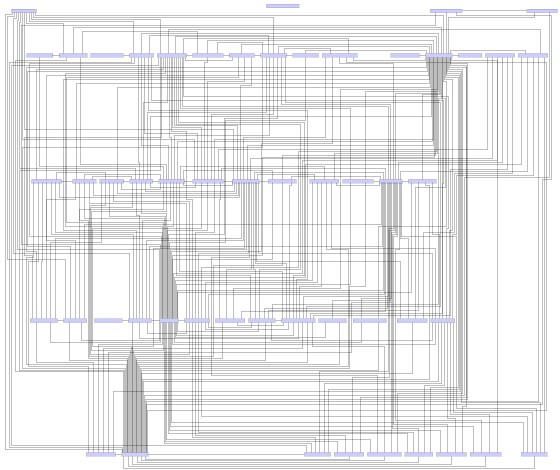

Components of an Eclipse RCP application in hierarchical layout, 2012

30 August 2019

Visualising Architecture: Neo4j vs. Module Dependencies

Last year I wrote about some work I did for a client using NATURAL (an application development and deployment environment using a proprietary language), for example using NATstyle, adding custom rules and creating custom reports. Today I will share some things I used to visualise the architecture. Usually I want to get the bigger picture of the architecture before I change it.

Industrial LegacyDependencies are killing us
Let's start with some context: This is Banking with some serious legacy: Groups of "solutions" are bundled together as "domains". Each solution contains 5.000 to 10.000 modules (files), which are either top level applications (executable modules) or subroutines (internal modules). Some modules call code of other solutions. There are some system "libraries" which bundle commonly used modules similar to solutions. A recent cross check lists more than 160.000 calls crossing solution boundaries. Nobody knows which modules outside of one's own solution are calling in and changes are difficult because all APIs are potentially public. As usual - dependencies are killing us.

Graph Database
To get an idea what was going on, I wanted to visualize the dependencies. If the data could be converted and imported into standard tools, things would be easier. But there were way too many data points. I needed a database, a graph database, which should be able to deal with hundreds of thousand of nodes, i.e. the modules, and their edges, i.e. the directed dependencies (call or include).

Extract, Transform, Load (ETL)
While ETL is a concept from data warehousing, we exactly needed to "copy data from one or more sources into a destination system which represented the data differently from the source(s) or in a different context than the source(s)." The first step was to extract the relevant information, i.e. the call site modules, destination modules together with more architectural information like "solution" and "domain". I got this data as CSV from a system administrator. The data needed to be transformed into a format which could be easily loaded. Use your favourite scripting language or some sed&awk-fu. I used a little Ruby script,
ZipFile.new("CrossReference.zip").
  read('CrossReference.csv').
  split(/\n/).
  map { |line| line.chomp }.
  map { |csv_line| csv_line.split(/;\s*/, 9) }.
  map { |values| values[0..7] }. # drop irrelevant columns
  map { |values| values.join(',') }. # use default field terminator ,
  each { |line| puts line }
to uncompress the file, drop irrelevant data and replace the column separator.

Loading into Neo4j
Neo4j is a well known Graph Platform with a large community. I had never used it and this was the perfect excuse to start playing with it ;-) It took me around three hours to understand the basics and load the data into a prototype. It was easier than I thought. I followed Neo4j's Tutorial on Importing Relational Data. With some warning: I had no idea how to use Neo4j. Likely I used it wrongly and this is not a good example.
CREATE CONSTRAINT ON (m:Module) ASSERT m.name IS UNIQUE;
CREATE INDEX ON :Module(solution);
CREATE INDEX ON :Module(domain);

// left column
USING PERIODIC COMMIT
LOAD CSV WITH HEADERS FROM "file:///references.csv" AS row
MERGE (ms:Module {name:row.source_module})
ON CREATE SET ms.domain = row.source_domain, ms.solution = row.source_solution

// right column
USING PERIODIC COMMIT
LOAD CSV WITH HEADERS FROM "file:///references.csv" AS row
MERGE (mt:Module {name:row.target_module})
ON CREATE SET mt.domain = row.target_domain, mt.solution = row.target_solution

// relation
USING PERIODIC COMMIT
LOAD CSV WITH HEADERS FROM "file:///references.csv" AS row
MATCH (ms:Module {name:row.source_module})
MATCH (mt:Module {name:row.target_module})
MERGE (ms)-[r:CALLS]->(mt)
ON CREATE SET r.count = toInt(1);
This was my Cypher script. Cypher is Neo4j's declarative query language used for querying and updating of the graph. I loaded the list of references and created all source modules and then all target modules. Then I loaded the references again adding the relation between source and target modules. Sure, loading the huge CSV three times was wasteful, but it did the job. Remember, I had no idea what I was doing ;-)

Querying and Visualising
Cypher is a query language. For example, which modules had most cross solution dependencies? The query MATCH (mf:Module)-[c:CALLS]->() RETURN mf.name, count(distinct c) as outgoing ORDER BY outgoing DESC LIMIT 25 returned
YYI19N00 36
YXI19N00 36
YRWBAN01 34
XGHLEP10 34
YWI19N00 32
XCNBMK40 31
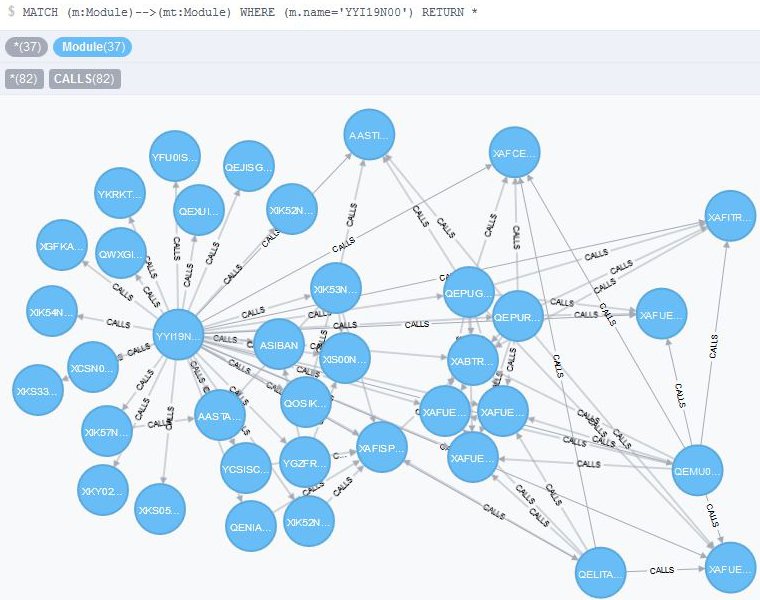
and so on. (By the way, I just loved the names. Modules in NATURAL can only be named using eight characters. Such fun, isn't it.) Now it got interesting. Usually visualisation is a main issue, with Neo4j it was a no-brainer. The Neo4J Browser comes out of the box, runs Cypher queries and displays the results neatly. For example, here are the 36 (external) dependencies of module YYI19N00:

Called by module YYI19N00
As I said, the whole thing was a prototype. It got me started. For an in-depth analysis I would need to traverse the graph interactively or scripted like a Jupyter notebook. In addition, there are several visual tools for Neo4J to make sense of and see how the data is connected - exactly what I would want to know about the dependencies.

15 August 2018

Creating your own NATstyle rules

Last month I showed how to use NATstyle from the command line. NATstyle is the utility to define and check the coding standard of your NATURAL program. Today I want to explain how to customize and create your own rules beyond what is explained in the manual. I used NaturalONE 8.3.5.0.242 CE (November 2016). Likely there are more options and rules available in newer versions of NaturalONE and NATstyle.

Basic Configuration
NATstyle comes packaged inside NaturalONE, the Eclipse-based IDE for NATURAL. As expected NATstyle can be configured in Eclipse preferences. The configuration is saved as NATstyle.xml which is used when you run NATstyle from the right click popup menu. We will need to modify NATstyle.xml later, so let's have a look at it:
<?xml version="1.0" encoding="utf-8"?>
<naturalStyleCheck version="1.0"
                   xmlns="http://softwareag.com/natstyle/rules"
                   xmlns:xsi="http://www.w3.org/2001/XMLSchema-instance"
                   xsi:schemaLocation="http://softwareag.com/natstyle/rules checks.xsd">
  <checks type="source">
    <check class="CheckLineLength" name="Line length" severity="warning">
      <property name="max" value="72" />
      <property name="exclude" value="D3" />
    </check>
    <!-- more checks of type source -->
  </checks>
  <!-- more checks of other types -->
</naturalStyleCheck>
(In the source, the default configuration file is res/​checks.xml together with its XML schema res/​checks.xsd.)

Existing Rules
The existing rules are described in NaturalONE help topic Overview of NATstyle Rules, Error Messages and Solutions. Version 8.3 has 42 rules. These are only a few compared to PMD or SonarQube, which has more than 1000 rules available for Java. Here are some examples what NATstyle can do:
  • Source Checks: e.g. limit line length, find tab characters, find empty lines, limit the number of source lines and check a regular expressions for single source lines or whole source file.
  • Source Header Checks: e.g. force header or check file naming convention.
  • Parser Checks: e.g. find unused local variables, warn if local variable shadows view, find TODO comments, calculate Cyclomatic and NPath complexity, force NATdoc (documentation) tags and check function, subroutine and class names against regular expressions.
  • Error (Message File) Checks: e.g. check error messages file name.
  • Resource (File) Checks: e.g. check resource file name.
  • Library (Folder) Checks: e.g. library folder conventions, find special folders, force group folders and warn on missing NATdoc library documentation.
Same rule multiple times configured differently
Some rules like Source/Regular expression for single source lines only allow a single regular expression to be configured. Using alternation, e.g. a|b|c, in the expression is a way to overcome that, but the expression gets complicated quickly. Another way is to duplicate the <check> element in the NATstyle.xml configuration. Assume we do not only forbid PRINT statements, we also do not allow reduction to zero. (These rules do not make any sense, they are just here to explain the idea.) The relevant part of NATstyle.xml looks like
<checks type="source">
  <check class="CheckRegExLine"
         name="Regular expression for single source lines" ... >
    <property name="regex" value="PRINT '.*" />
  </check>
  <check class="CheckRegExLine"
         name="Regular expression for single source lines" ... >
    <property name="regex" value="REDUCE .* TO 0" />
  </check>
</checks>
While it is impossible to configure these rules in the NaturalONE preferences, it might be possible to run NATstyle with these modified settings. I did not verify that. I execute NATstyle from the command line passing in the configuration file name using the -c flag. (In the source, see the full configuration res/​sameRuleTwice.xml and the script to to run the rules bin/​natstyle_sameRuleTwice.bat from the command line.)

rock piles of different sizeDefining your own rules
There is no documented way to create new rules for NATstyle. All rules' classes are defined inside the NATstyle plugin. The configuration XML contains a class attribute, which is a short name, e.g. CheckRegExLine. Its implementation is located in the package com.​softwareag.​naturalone.​natural.​natstyle.​check.​src.​source where source is the group of the rules defined in the type attribute of the <checks> element. I experimented a lot and did not find a way to load rules from other packages than com.​softwareag.​naturalone.​natural.​natstyle. All rules must be defined inside this name space, which is possible.

Source Rules
While I cannot see the actual code of NATstyle rules, Java classes expose their public methods and parent class. I did see the names of the rule classes in the configuration and guessed and experimented with the API a lot. My experience with other static analysis tools, e.g. PMD and Pylint and the good method names of NATstyle code helped me doing so. A basic Source rule looks like that:
package com.softwareag.naturalone.natural.natstyle.check.src.source; // 1.

import com.softwareag.naturalone.natural.natstyle.NATstyleCheckerSourceImpl;
// other imports ...

public class FindFooSourceRule
  extends NATstyleCheckerSourceImpl { // 2.

  private Matcher name;

  @Override
  public void initParameterList() {
    name = Pattern.compile("FOO").matcher(""); // 3.
  }

  @Override
  public String run() { // 4.
    StringBuffer xmlOutput = new StringBuffer();

    String[] lines = this.getSourcelines(); // 5.
    for (int line = 0; line < lines.length; i++) {
      name.reset(lines[line]);
      if (name.find()) {
        setError(xmlOutput, line, "Message"); // 6.
      }
    }

    return xmlOutput.toString(); // 7.
  }
}
The marked lines are important:
  1. Because it is a Source rule, it must be in exactly this package - see the paragraph above.
  2. Source rules extend NATstyleCheckerSourceImpl which provides the lines of the NATURAL source file - see line 6. It has more methods, which have reasonable names, use the code completion.
  3. You initialise parameters in initParameterList. I did not figure out how to make the rules configurable from the XML configuration, which will probably happen in here, too.
  4. The run method is executed for each NATURAL file.
  5. NATstyleCheckerSourceImpl provides the lines of the file in getSourcelines. You can iterate the lines and check them.
  6. If there is a problem, call setError. Now setError is a bit weird, because it writes an XML element for the violation report XML (e.g. NATstyleResult.xml) into a StringBuffer.
  7. In the end the return the XML String of all found violations.
Finally the rule is configured with
<checks type="source">
  <check class="FindFooSourceRule"
         name="Find FOO"
         severity="warning" />
</checks>
(In the example repository, there is a working Source rule src/​com/​softwareag/​naturalone/​natural/​natstyle/​check/​src/​source/​FindInv02.java together with its configuration res/​customSource.xml.)

Parser Rules
Now it is getting more interesting. There are 18 rules of this type, which is a good start, but we need moar! Parser rules look similar to Source rules:
package com.softwareag.naturalone.natural.natstyle.check.src.parser; // 1.

import com.softwareag.naturalone.natural.natstyle.NATstyleCheckerParserImpl;
// other imports ...

public class SomeParserRule
  extends NATstyleCheckerParserImpl { // 2.

  @Override
  public void initParameterList() {
  }

  @Override
  public String run() {
    StringBuffer xmlOutput = new StringBuffer();

    // create visitor
    getNaturalParser().getNaturalASTRoot().accept(visitor); // 3.
    // collect errors from visitor into xmlOutput

    return xmlOutput.toString();
  }
}
where
  1. Like Source rules, Parser rules must be defined under the package ...natstyle.​check.​src.​parser.
  2. Parser rules extend NATstyleCheckerParserImpl.
  3. The NATURAL parser traverses the AST of the NATURAL code. Similar to other tools, NATstyle uses a visitor, the INaturalASTVisitor. The visitor is called for each node in the AST tree. This is similar to PMD.
Using the Parser
Tree, MuthillThe visitor must implement INaturalASTVisitor in package com.​softwareag.​naturalone.​natural.​parser.​ast.​internal. This interface defines 48 visit methods for the different sub types of INaturalASTNode, e.g. array indices, comments, operands, system function references like LOOP or TRIM, and so on. Still there are never enough node types as the AST does not convey much information about the code, most statements end up as INaturalASTTokenNode. For example the NATURAL lines
* print with leading blanks
PRINT 3X 'Hello'
which are a line comment and a print statement, result in the AST snippet
+ TOKEN: * print with leading blanks
+ TOKEN: PRINT
+ TOKEN: 3X
+ OPERAND
  + SIMPLE_CONSTANT_REFERENCE
    + TOKEN: 'Hello'
Now PRINT is a statement and could be recognised as one and 'Hello' is a string. This makes defining custom rules possible but pretty hard. To help me understand the AST I created a visitor which dumps the tree as XML file, similar to PMD's designer: src/​com/​softwareag/​naturalone/​natural/​natstyle/​check/​src/​parser/​DumpAstAsXml.java.

Conclusion
With this information you should be able to get started defining your own NATstyle rules. There is always so much more we could and should check automatically.

3 July 2018

Using NATstyle from the commandline

Last year a new client contracted me to help them make their development process, their development environment and tooling "state of the art" (aka up do date). From the coding perspective that included - among other things - using a decent IDE, writing unit tests, having some Continuous Delivery pipeline in place and using static code analysis. I thought that it should not be too difficult, right? It was, but that is not the goal of this article. Today I want to describe the static analysis features and how to use it.

Earth Sapphire Progress Picture 30 july-2011NATURAL
The code base was NATURAL. NATURAL is an application development and deployment environment using a proprietary language maintained by Software AG. It was created in 1979. André describes it as Cobol's ugly, brain-damaged, BABBLING IN ALL-CAPS - but regrettably still healthy and strong - cousin.. ;-) Well, it is a procedural language structured using modules, subroutines and functions. It feels as old as it is. For example, module names are limited to eight (8!) characters and there is no way to structure the modules further. An enterprise application might contain 5.000 to 10.000 modules. To me NATURAL feels much like early Pascal: units (modules), subroutines and functions together with the eight characters DOS name limit. I really liked Pascal back then and I do not feel that bad about NATURAL. Probably also because I do not have to use it on a daily basis.

NaturalONE and NATstyle
NaturalONE is the Eclipse-based tool for NATURAL by Software AG. It looks pretty good, similar to what you would expect from Eclipse. It contains the usual features like Outline, Search, Debug and something called NATstyle. Now NATstyle - which probably on purpose sounds similar to the well known Checkstyle - is an utility to define and check the coding standard in your programs. It is used inside NaturalONE, see a NATstyle Demo by Software AG. (For more information refer to the Eclipse/NaturalONE help topic Checking Natural Code with NATstyle.)

Invoking NATstyle from outside NaturalONE
I like static code analysis and consider it a mandatory component of every delivery pipeline. As I said above, I wanted to have some static code analysis and was wondering if I would be able to run NATstyle in the pipeline? I did not find any information on the topic and was forced to experiment. I used NaturalONE 8.3.5.0.242 CE (November 2016) and figured out several ways, which were hardly documented, and might be subject to change. Likely there are other options available in newer versions of NaturalONE and NATstyle.

Invoking NATstyle from command line
NATstyle is just an Eclipse plugin inside NaturalONE. In my edition it is the folder C:\Natural-CE\​Designer\​eclipse\​plugins\​com.​softwareag.​naturalone.​natural.​natstyle_8.3.5.0000-0242. With the proper class path it is possible to invoke NATstyle's main method, which prints help on its usage:
Usage: com.softwareag.naturalone.natural.natstyle.NATstyle [-options]

where options include:
  -projectpath <directory> Specify where to find the Natural project.
  -rootfolder              Library root folder support enabled.
  -c <file>                Specify the configuration file.
  -o <file>                Specify the output file.
  -sourcefiles <srcList>   Specify list of source files to be loaded.
                           separated with ;
  -libraries <libList>     Specify list of libraries to be loaded.
                           separated with ;
  -exclude <libList>       Specify a list of libraries to exclude.
                           separated with ;
  -p <directory>           Specify where to find additional packages.
  -help                    Display command line options and exit.

Make sure the following classes can be found in your class path:

com.softwareag.naturalone.natural.auxiliary
com.softwareag.naturalone.natural.common
com.softwareag.naturalone.natural.parser
Nice, that looks like the developers from Software AG prepared NATstyle to be called stand-alone in my pipeline. +1. All the necessary classes can be found in the following plugins of Eclipse/NaturalONE:
  • Folder com.softwareag.naturalone.natural.natstyle_8.3.5.0000-0242
  • Jar com.softwareag.naturalone.natural.auxiliary_*.jar
  • Folder com.softwareag.naturalone.natural.common_8.3.5.0000-0242
  • Jar com.softwareag.naturalone.natural.parser_*.jar
  • Jar org.eclipse.equinox.common_*.jar
These are all bundles defined by Eclipse/OSGi. The list of dependencies of these bundles also contains the following Jars
  • org.eclipse.swt.win32.*.jar
  • org.eclipse.ui.console_*.jar
which (in my experience) are not needed to use NATstyle. NATstyle does not use any other OSGi features and we can set the needed class path by hand. Here is an example how to do that in the Windows shell when NaturalONE is installed:
set N1=C:\Natural-CE\Designer\eclipse\plugins
set CLASSPATH=^
%N1%\com.softwareag.naturalone.natural.natstyle_8.3.5.0000-0242;^
%N1%\com.softwareag.naturalone.natural.auxiliary_8.3.5.0000-0242.jar;^
%N1%\com.softwareag.naturalone.natural.common_8.3.5.0000-0242;^
%N1%\com.softwareag.naturalone.natural.parser_8.3.5.0000-0242.jar;^
%N1%\org.eclipse.equinox.common_3.6.200.v20130402-1505.jar

java com.softwareag.naturalone.natural.natstyle.NATstyle %*
Download the source and see bin/run_natstyle for the script I used to run NATstyle directly. Copying the needed folders and Jars to another machine works well. I recommend to create a Jar from the folders before copying them around. bin/_create_jar shows how to do that. Make sure not to include META-INF\*.RSA or META-INF\*.SF into the new Jars because the checksums do not match. bin/copy_jars does the actual copying into the lib folder.

Invoking NATstyle from Ant
NaturalONE supports Ant for some automation tasks. There is no specific NATstyle Ant task, but calling it from Ant is straight forward. If the path <path id="natstyle.classpath"> is set up to contain all the Folders and Jars, NATstyle is executed via Ant's java task:
<java taskname="natstyle"
      classname="com.softwareag.naturalone.natural.natstyle.NATstyle"
      dir="${basedir}" fork="true" maxmemory="128m"
      failonerror="true"
      classpathref="natstyle.classpath">
  <arg value="-projectpath" />
  <arg value="../NatUnit/NatUnit_L4N" />
  ...
</java>
A new JVM needs to be forked because NATstyle calls System.exit() at the end. All parameters are the same as for the command-line invocation and are passed in via the <arg /> element. In the source, see ant/ant_NatStyle.xml for the complete Ant script.

Reporting
NATstyle writes an XML report of all files if worked and found rule violations. The structure is
<NATstyle>
  <file type='...' location='...'>
    <error severity='...' message='...' />
    ...
  </file>
  ...
</NATstyle>
Inside the folder of NATstyle (i.e. com.softwareag.naturalone.natural.natstyle_8.3.5.0000-0242) there is a subfolder NATstyle. It contains sample files. Using the provided NATstyleSimple.xsl the report XML (e.g. NATstyleResult.xml) can be transformed into a human-readable format (e.g. NATstyleSimple.html). When using NATstyle stand-alone, you might want to copy this folder as well. XSLT transformation task is part of Ant and converts the XML to HTML.
<xslt basedir="${basedir}"
      destdir="${basedir}/report"
      style="${basedir}/NATstyle/NATstyleSimple.xsl">
  <include name="NATstyleResult_*.xml" />
</xslt>
See ant/ant_NatStyleResultToHtml.xml for the complete Ant build script to convert the NATstyle result XML into a readable HTML report. Using your own stylesheet (.xsl) allows you to customize the report. See how to convert the report into more complex formats.

Next time I will show you how to write your own NATstyle rules.