Showing posts with label about. Show all posts

15 September 2026

My Writing and GenAI

I follow my plan of focusing on fewer tasks. This puts a lot of pressure on my time. In addition I spent almost every evening of the last months exploring GenAI. My wife got sick of me talking about agents, tokens and the like. Besides my feelings about the change of our industry I did not write much. Having little time and less practise in writing made writing more unlikely - a vicious cycle. I had no idea where putting my thoughts would end up. It might become a rant. (Sidebar 1)

The Giant Bible of Mainz (licensed CC BY by Karen Neoh)Working With Text
What to look for? I use writing to structure my thoughts. This is rubber ducking, a practise of talking through a problem. In doing so, your brain structures the problem as part of communication. This often lets us find the solution to the problem. I learnt about this technique from The Pragmatic Programmers, a book I recommend since 2011. The idea itself is way older and based on Joseph Weizenbaum's ELIZA from 1966. (You can try ELIZA here.)

More than once the outcome of my writing was different than I had expected or planned. I partitioned and analysed the problem during writing and found better results. This is the benefit. I lose if AI writes the text for me. It will format my notes nicely and present something that looks reasonable but it will not end with opposing results. And even if it would, I would reject them because I am unprepared for opposing results. I need to go through the work of structure and analysis to find and accept a different outcome than I had anticipated. My writing needs to be slow and meandering and cumbersome.

When writing about technical topics, e.g. the latest Coding Fun, I have to structure the material linearly to make it possible to read for people who are unfamiliar with what I want to present. This makes me reflect on the topic from a distance, after I had been in the fine details all the time. This summary adds to my understanding of the material.

On LinkedIn is a group of people who claim that they put as much thought and effort into their AI generated articles - which would also mean they get the same benefits. I do not know, maybe they do. But Mathias Verraes disagrees. He claims to recognise AI-generated text because he read so much. The generated text contains the same cliches and seems to be uniform - for sure statistically averaged. These articles are boring which makes them unreadable. (Sidebar 2)

I do not write enough and miss practice. Getting started is difficult, collecting ideas takes time and I edit everything more than once. I guess Mathias will resent my writing. ;-) I struggle with articulation as English is not my first language. I could use GenAI to improve my articulation - it would keep my ideas and thoughts, at least according to the proponents of GenAI. But I reject it. I want to improve my articulation myself. Articulation is a skill, writing is a skill, and both need practise. (Sidebar 3)

I like writing by hand, or should I call it writing manually: I am creating something and showing the world. Using GenAI for my writing removes all these benefits: I am not structuring, expressing, and polishing my thoughts. I am not summarising known material. And I am not practising and improving my writing. Dylan Beattie phrased it in his GeeCON 2026 keynote: "If something is fun and you're learning - using AI brakes both."

What Makes A Person?
Another goal of my writing is to share my knowledge. Other than expressing myself, sharing is a marketing tool, at least part of developer branding. As GenAI disturbs my beloved coding, I need to rethink my business. What makes me successful since 15 years? Besides my technical expertise I believe I am successful because I am authentic. I teach what I know and have experience from past projects and always state up front when I have no clue. (Sidebar 4) I avoid marketing buzz words and stay away from promising anything. I demand perfection from others and even more from myself. I live what I preach. I have no idea what my clients buy when they hire me for the first time (when they do not know me yet). I believe they buy the promise of my reputation. All my work comes through personal recommendations. (Thank you so much my friends.) For sure a large part of my business depends on my contacts and personal, authentic connections. Being honest, admitting mistakes and taking responsibility for my actions are important to me. No generated text, regardless how well structured and nicely sounding, supports those.

News block (licensed CC BY-SA by Loco Steve)Generated Correspondence
In the early days of Chat-GPT I ran an inhouse Coderetreat for one of my clients. A local organiser sent an invitation to all developers. Instead of writing one or two sentences about the upcoming event, he generated a full page of text about being "delighted" to host such a "spectacular" event and more exaggerated terms. This is a common problem. Me friend Raimo writes about interacting with coworkers talking to us only through parrots which makes him frustrated or angry at times. I fail to understand why people would do that. (Sidebar 5) Particular in an corporate environment, nobody cares for style or typos in work emails. As time is money, long emails and chat messages are discouraged. The respect for our coworkers' time should stop us from creating (large amounts of) useless text. Please never send me AI generated text. I will never use AI for mails or personal messages.

I am a geek, spending my evenings alone, in a dark room filled with hardware and pizza boxes - at least kind of. And at the same time I like working with people. I value human connection. It makes much of my work meaningful and worthwhile. Human beings are social, everybody needs human connection somehow. To connect I need to express my feelings (like about accepting GenAI) and I want to be seen. AI is unable to express my feelings and it certainly can not make me seen. Connection is not happening if I do not expose myself.

My AI Writing Manifesto
After collecting notes and thoughts since May this year, structuring my thoughts and polishing then, I found clarity:
  • I structure and formulate my thoughts and ideas myself. AI does not support me in digesting and distilling content.
  • I summarise technical expertise myself. AI does not support me in finding deeper relations based on known material.
  • I author and polish my writing myself. AI does not support me in practising and improving my writing skill.
  • I keep a honest and authentic relation to my clients and peers. AI is neither.
  • I respect your time and keep all messages short. AI generates bloat.
  • I write all messages myself to express my feelings and to be seen. AI hides me.
  • All images I use are real images, unless marked as AI generated.


Footer
I was massively distracted while writing. I kept finding notes from the last five months on different aspects of this. The topic had been on my mind for some time. After finishing the outline I streamlined the text and moved my secondary thoughts into this section. While off-topic these thoughts were reasonable - I might expand on them later.

Blog Rants: I have not written any rant since I went independent. This is a good thing. I do not miss the corporate politics and hidden agendas.

Hate of Generated Text: In my social "bubble", there is a crusade against AI generated text. I can relate. The massive creation of AI slop is speeding up the Enshittification of the Internet. For example: This January I suffered from pneumonia. Staying in bed I searched the web for articles comparing AC generators. I planned to buy one powering tools in the garden. The web search showed promising results. But each page turned out to contain generated text of products with deep links into Amazon, and no real descriptions nor any comparison. Maybe due my weakened state, I was devastated. I recognised that the Internet was broken. That was not the web I had learnt to trust for its usefulness.

Practice and Mastery: I am a big fan of deliberate practise. I practice deliberately since many years and have talked about it in the past. I use that approach for all areas which I care for and where I want to improve. I want to achieve mastery (as a path not a state). Maybe this is folly: I am in a position of privilege which allows me to reflect on my skills and put aside time to practise, which is like play, unproductive. I am able to laugh about failed attempts and try again. I like the experience of the flow you get after reaching a certain level of skill. Having invested huge amounts of time into practise makes me respect the effort and skills of other people. Coming back to AI writing - I am unable to respect neither the author nor the work using AI because there is little effort and skill required.

Working with technologies I do not know is an interesting situation as a coach. I always confess in the first meeting with the client when I have no experience with certain technologies they are using. 12 years ago, I worked with a company using PHP. Back then, they used PHP 5, which had a bad reputation. I had never seen any PHP before. I struggled a lot with its dereference operator -> and always used the more common . instead. When pair programming I always mistyped it and one of my pairing partners designed a T-shirt for me saying "this -> is not this .". In the end I knew more about PHP than most developers I paired with because I knew what to expect from a language and how to google it. Another time I worked with C# which I had never touched before. That was even easier, as at the time, C# was "Java in Pascal case". ;-) After learning some programming languages, at least the main stream ones, all languages look the same.

Why generate bloated text? I am wondering which universal human need is met when people generate work emails with GenAI, making them many times larger than necessary. It is not efficiency, as the prompt takes longer than the pure message. It is not reputation, as everybody recognises the generated text. (Ha ha sequences of "it is not" are a sign of AI generated text. Fear not dear reader, I am able to author bad writing without any AI any day. ;-) People generate content for Wikipedia - which is vandalism and go on when asked about it. Which need is met by these actions? I will have to investigate. The best I know is "because I can" which is self-efficacy, an important need indeed.
15 March 2023

I want you to exceed me

During my time at IBM I started coaching other teams. It was fun and I liked it. Later I went into full time training and coaching, and my motto was "Developing Quality Software Developers". I knew it was the thing I wanted to do, but I did not know why.

Gamification
I use Gamification as a strategy to improve user engagement. To increase participation in my workshops and to express my feelings about that, I created achievement cards, the Code Cop Achievement Cards. Achievements or trophies are concepts from video games, and describe meta-goals defined outside the game's parameters. Meeting the fulfilment conditions, and receiving recognition of fulfilment by the game, is referred to as unlocking the achievement. There are several cards for first time participants in my deck, for example Shortcut Fu when someone uses a rare keyboard short-cut, Regexer for comprehending a crazy regular expression or Finisher for finishing the coding exercise started during the workshop at home - which I always offer but rarely happens. I award these cards to a participant, if I feel that the person has worked hard or struggled to make it.

Appreciation
I wanted my cards to convey my honest appreciation and used NVC (Non-violent Communication) appreciation statements. For a NVC-style appreciation we share the specific actions that contributed to our well-being, the needs that have been fulfilled, and the feelings engendered by the fulfilment of those needs. The focus is to create a clear understanding of how our life was enriched.. This made me think more about my feelings and which of my needs had been satisfied at the moments when I wanted to appreciate some action. I had thought about needs before in more general, less personal way. My friend and NVC coach Aki Salmi helped me to formulate these statements using different phrases to avoid having the same text on each card again and again: For example: "I value the usage of short-cuts as effective and as sign of ongoing mastery in our craft." "I am touched to see courage in situations of uncertainty, risk and emotional exposure." "I am amazed by critical questions based on creativity and independent thought." "I am inspired by the integrity and consistency of sticking to principles in difficult situations." The process of finding the right words alone strengthened my ability to express my feelings dramatically.

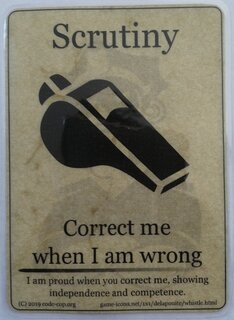
Very Personal Appreciation Badge (copyright Peter Kofler) Scrutiny
Some of my appreciation cards celebrate learning, including stepping out of one's comfort zone, which is required for learning. One card I of these is titled "Scrutiny", subtitled Correct me when I am wrong. It shows a Whistle icon (by Delapouite CC BY 3.0) and the appreciation is "I am proud when you correct me, showing independence and competence." It does not happen often - still sometimes in a pairing or ensemble session, my focus may slip and I make a mistake or do not call out a mistake on time. And then, sometimes, someone else does.

Growth
There is a common theme in most of my cards: growth. Now that I have seen it, it is obvious to me. Growth is one of my major needs. I want to grow - e.g. learning new languages and other stuff regularly. And I want the people I coach and work with to grow, too. My second motto - surfacing around 2013 - "Developing Quality Software Developers" expresses that clearly. I want them to grow, to learn, to improve - and I am inspired and amazed the most, when they exceed me.

Snatch the Pebble From My Hand
There is nothing more satisfying than when a pupil exceeds his or her master. This is often depicted in movies, where a student must learn a lot, for example in Kung Fu movies: In the television series Kung Fu, Caine is an orphan and is accepted into a Shaolin Monastery. Part of the Shaolin way of life is strengthening the body and the mind. For example, one of Caine's teachers asks him to "snatch the pebble from my hand":


Then, after many years of training, Caine is finally able to beat his master:


What a satisfying moment, and Caine's master smiles. This is one of my favourite TV moments ;-) Like being corrected (see Scrutiny card above), "snatch the pebble from my hand" situations make me proud of my students.

Make Me Look Like a Baby
I want to leave you with a quote from a different and maybe more controversial source of motivation than Caine, ex Navy SEAL member Jocko Willink: Don't try and be like me. Be better than me. Crush me. Make me look like a baby. That's what you do. (Even better when he says it himself.) - OK, maybe there is too much testosterone here ;-)

14 July 2022

Moving away from SlideShare

lost playground (licensed CC BY-SA by liebeslakritze)One of my learning activities is watching recordings of conference presentations, especially ones which have been recommended by trusted colleagues and peers. (You can find presentations which I recommend myself on YouTube and Vimeo.) After watching I usually download the slides and store them in my knowledge base, together with notes I might have taken during the presentation. At the moment my software development knowledge base is around 6G text files and PDFs, but that is a topic for another time.

From time to time I present at conferences or run a Coding Dojo. Afterwards I want to share my slides and I want you to be able to download them. In 2013 I started using SlideShare for that. I liked it and it worked well. It organised my slides and added the social aspect on top, e.g. I connected with other people sharing slides and kept track of favourites. Since Scribd acquired SlideShare I am not satisfied any more. I am facing technical problems uploading new slides again and again which is frustrating. Additionally downloading slides seems to require a paid membership. While I understand that free services need money to operate, I really want my slides to be available for download.

So I am moving away from SlideShare, or at least I am duplicating it. I did not follow my own advice to avoid third party SaaS - and as in the past I have to deal with the consequences now. I uploaded all slides I had shared on SlideShare to my own folder on my web space. It is just a folder and not as fancy as SlideShare, but you can download! Enjoy my slides.

31 July 2018

Strong Opinions

As Code Cop I meet a lot of developers and I have to tell some of them that their code is crap and that they need to drive down their technical debt. Others need to test more, maybe start doing TDD. There are a few who would not listen. Some of them are even proud of stubbornly not listening, they say that they have strong opinions about the topic. They do not seem interested in in another view on their code or design? Why is that? I have some ideas.

GorillaDunning Kruger Effect
The Dunning Kruger Effect is a cognitive bias in which people of low ability have illusory superiority and mistakenly assess their cognitive ability as greater than it is. In other words, beginners believe themselves senior and think that they know better. There is no need to listen to an outsider.

I know this effect myself: When I learnt my first programming language(s), as soon as I could write a few lines of code, I felt invincible. (I thought that) I could do everything. I ruled. I knew how to do it and I knew I was right and that there was no other way to do it properly. Today, after writing code for 20 years in more than 25 languages, I do not feel like that any more. Sometimes I would like to go back to my state of mind of the late nineties and I try to look at new languages like a child - with a beginner's mind - but I know too much details. I know there will be nasty details, even for that newest and hottest languages of today.

Expert Beginner
An expert beginner has quickly reached (what looks like) expert status. He or she voluntarily ceases to improve because of a belief that expert status has been reached and thus further improvement is not possible. (I recommend reading the whole series of Erik Dietrich, How Developers Stop Learning: Rise of the Expert Beginner and further posts of his series.) Expert beginners make up defending arguments because they are the experts.

I have met some of these. I vividly remember two senior developers who had been with one of my clients for more than 16 years. They were opposing me on everything I said. Sure they had a superior knowledge of the application they had built and maintained for so many years, and they knew the domain they were working in pretty well. I am sure they were adding value to the product. They both were strong influencers. As soon as they would speak their mind, all other team members would just agree. But, but, but... Sigh. They were still using Ant, did not know Maven, did not write unit tests, did not care for clean code and so on - they made me very unhappy.

Quadrants of Knowledge
The quadrants of knowledge seem connected to my previous points. The four quadrants are
  1. Known Knowns: What you know that you know
  2. Unknown Knowns: What you do not know that you know
  3. Known Unknowns: What you know that you do not know
  4. Unknown Unknowns: What you do not know that you do not know
When we advance our career in software delivery, we learn: We collect concrete knowledge (quadrant 1), we gain experience which allows us to have gut feelings about some things (maybe quadrant 2) and we hear about things that we have no idea about (quadrant 3). There are gazillion things in software that I have no idea of: ANTLR, APL, AWS, Category Theory, Distributed Computing, Elm, Gradle, Guava, Haskell, HBase, J2EE, Kubernetes, Mongo DB, Networking, Node.JS, Prolog, Security - these are just the first few that come to my mind. It is easier to list things which I do not know in areas that I do know. I have been Java developer for 15 years and there are so many things in the Java ecosystem which I have no clue about. On the other hand there are not many things I can say about C#, because I only know it little.

So the more we learn, the more we know that we do not know, increasing our Known Unknowns (quadrant 3). The philosopher Confucius (551–479 BC) even said, Real knowledge is to know the extent of one's ignorance. Like the Dunning Kruger Effect, beginners have no idea about the vast size of Known Unknowns quadrant and do not expect surprises or potential improvements.

Strong Opinions, Weakly Held
The ideas of the Dunning Kruger Effect, Expert Beginners and Known Unknowns offer some explanation why some junior developers are not open for discussions. I have also met senior and expert level developers who are the same. When attending Software Crafting unconferences, e.g. SoCraTes, attendees are eager to learn and open for discussion. After all, that is the idea of unconferences, right? Still, many of them have strong opinions about almost everything, e.g. Spring Boot is cool. No, Spring Boot is hell. ;-) Different from beginners, all of them know the problems of strong opinions and claim that they only hold onto them weakly.

Deal with itWeakly Held, what is that supposed to mean? Isaac Morehouse explains in These Four Words Will Help You ‘Hold Strong Opinions Weakly': You act as if they [your opinions] are true unless and until it is proven they are not. Maybe people like strong opinions because they give them the power of definiteness. Choices are much easier and life is more predictable with definiteness and absolutes. Holding opinions weakly also gives the power of openness. This sounds hard: Basing one's actions on some definite "truths" and re-evaluating these truths whenever they are challenged. Seems like a difficult balancing act, if not a contradiction. For sure that state of mind is not easy to get into. I still need to see someone with strong opinion - weakly held or not - to change his or her mind,

Rant
When I started this article, it was supposed to be a rant. As usual, writing down my thoughts helped me to structure the material in a better way. (I consider writing an act of learning.) So where is the rant? Here it is:

Person with strong opinion == arsehole who does not want to listen.

That is a bit harsh, I agree. Obviously beginners need to listen more and due to Known Unknowns I expect experienced and expert developers to be open to discussion on any topic at any time. The strong opinion itself is not the problem, but the resulting behaviour, especially if strong opinion is used as warning or justification of some sort. I witness strong opinion mainly as excuse to not discuss or challenge existing views.

What about me?
Of course I had strong opinions during my professional life. I did not earn the nick name of Code Cop for nothing. Someone even called me Code Nazi. And my opinions were definitely not weakly held. I like absolutes. (Now I see - as I just learned above - the power of definiteness.) I guess I still have some strong opinions, and they are not just opinions, they are dogma: a system of principles proclaimed as unquestionable.

I have changed and it seems that the Code Cop is getting soft. ;-) The extended experience and discussions have weakened my definiteness. There is always some special case, the almighty it depends. And since I am working with people, and try to help them, I am more compassionate. I understand their problems, the difficulty to get time for quality and the pain of legacy code. Sometimes I catch myself not recommending what I believe the technically best course of action because it will be a lot of unpleasant, hard work for the team. No, that is too soft. If they made a mess, they have to fix it. Time to fall back on dogma. (Sound of firing cannons in the background ;-) All the time these balancing acts...

12 December 2017

Code Cop Knit Doll

Sometimes I present books to individual developers. On one side I am thanking them for "listening" to me - that is the good collaboration and supporting me - and on the other side I want to push them more into reading mandatory books. In preparation for Christmas I gave away a few pieces of Bad Tests, Good Tests by my friend Tomek Kaczanowski. Now imagine how surprised I was when Corinna repayed me with a Code Cop knit doll:
Code Cop Doll (click for high resolution image)
This is amazing. I love the number of detail she put on it:
  • I am obviously a cop with both gun (on my right side) and handcuffs (on my left side). The doll is also showing my age, especially the wild hair, grey beard and round belly. ;-)
  • There is the Ruby Logo on my police cap and chest. I did not know how much I evangelise the use of Ruby. It is true, Ruby is my favourite programming languages, although I am not using it that often any more.
  • I am going nowhere without my own keyboard, so there has to be a Das Keyboard in front of me at all times.
  • One of my mantras in trainings is to "Refactor Mercilessly". It seems I am using that one a lot.
Merry Xmas Everybody!

11 March 2013

Moved to Slideshare

Green WhiteboardAfter watching a presentation about SlideShare by Luis Suarez, the "E-mail-less Man", I decided to give it a try. I brushed up some of my past presentations and uploaded them to SlideShare. New slides will be added occasionally, so stay in touch. Thank you Luis for motivating me ;-)

6 August 2012

Code Cop Kofler

Summer began last month in Austria and I went abroad and got myself a lovely souvenir: a carved wooden desk name plate. I was not sure what to write there and thought about my twitter name but did not trust the artificer to cope with the @-sign and ended with some kind of hybrid name:

Code Cop Kofler
In hindsight I was clever not to ask for something complicated because the guy messed it up twofold and did not even get the letters of my name right. Nevertheless it is an icon of my office and I love it. If only I had a desk to put it on.

My Open Source Involvement

My current employer is refreshingly serious about software licenses. For example if an open source library is GPL licensed, it just cannot be used in a product or service offering. End of story. All other companies, I have ever worked for, just did not care. I like being serious about software. But it is not just about using the software, in fact it is about being contaminated with someone else's intellectual property, whatever this might be. To comply with my employer's bureaucracy I have to report my open source involvement and get written permission from my manager. Ok, so let's collect all my active open source projects and list them here as well. Some advertising never hurts.

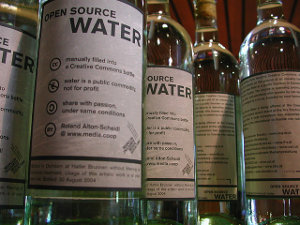
Open Source Water Bottles
  • It began with PMD (BSD License), a source code analyser for Java, which I used a lot. In 2004 I started submitting patches and later I created my own set of custom rules as Maven module. Unfortunately the new PMD 5.0 is not backward compatible, so I have some pending work to do here. (Source Code)

  • In 2008 I created a system tray notifier to monitor build servers under BSD license. I use it myself and have to create maintenance releases from time to time. (Ah delicious dog food ;-)

  • javaclass-rb is a Java class file parser in Ruby. I created it in 2009 and I there is a small release once a year. Although it is not finished, it is particularly useful to analyse custom Java code. I hope that I will have some time in the future to describe it in detail.

  • Since last year I am organizing Hackergarten Vienna. Hackergarten is a craftsman's workshop, a classroom, a laboratory, a social circle, a writing group, a playground and an artist's studio. We meet once a month and work on Open Source. During this time I have submitted patches with working code to Commons Exec, Castor, Commons Email and JMeter (all under Apache License).

  • My latest project is BaDaDam, an experimental BDD framework for Java. It allows you to write stories in plain text, implement them in Java classes and just run them using JUnit. Some people from Hackergarten have helped me with contributions.

  • Occasionally I submit pieces of code to Rosetta Code, a programming chrestomathy site.

2 January 2012

Code Cop goes Blue

It has been six months since I went "blue". After having some minor problems in the beginning I have settled down. Recently I completed the second learning plan on how to become a true IBMer, so I feel like changing my Code Cop character a little ;-)

Code Cop

1 July 2011

My Favourite Topic

Last month I had the opportunity to take part in a job assessment of the Austrian Software Test Experts. The managing directors and I have been friends since long as would be expected from guys who say that "software test is cool" and a "fanatic about code quality". I was looking forward to meeting the whole staff of testing experts.

FavoriteThe CEO had asked me to prepare an introduction and a short presentation about some code quality related topic. Unfortunately I had a very busy time and wasn't able to prepare anything in-depth. The night before I just hacked together a little presentation by copying all kind of slides from some of my previous presentations. Stealing the joke from Uncle Bob's talk Craftsmanship and Policy (2:30), I titled it My Favourite Topic, which is of course - me. ;-)

Feedback
I didn't take the presentation too seriously however the CEO said it was hilarious, almost comedy styled. People who had known me liked it a lot. But it turned out that I did a really poor job. Half of the audience didn't get the joke and therefore did not know what I was talking about. They got the humorous, self-deprecating introduction wrong and were discussing if I was disrespectful or just unprofessional. They hauled me over the coals.

3 November 2009

I am 1337!

Yesterday Andreas mailed me this screen shot from my Stack Overflow profile:

1337
together with this explanation "elite => eleet => e1337 => 1337". Aha, this proves that I'm elite. Well - maybe - I don't know. But nevertheless thank you Andreas for feeding my delusions of grandeur. ;-)

22 April 2009

About the Code Cop

The Big IdeaThree weeks ago I attended the eJug Days in Vienna. It was a little conference with some nice presentations. I hadn't been to a conference for some time and was highly motivated. At the end of one particularly cool talk, when the speaker showed his last slide containing the address of his personal web site, a thought hit me. "Man", I thought, "I should have some nice web page with all my stuff put together in one place." This should save my job from going to India ;-) This was the beginning of Code Cop dot org.

I am a senior developer and have been working with Java and internet related technologies since 1999. And I am a completionist. I like my code being in order, e.g. nicely formatted, readable, proper named, designed, tested etc. In fact I am fanatic about it, sometimes even forced to keep it neat. For example a colleague calls me to his place to discuss some problem and I spot some minor flaw in the code on the screen, e.g. he wrote static public instead of public static. I'm getting mad. I am unable to listen to him till the flaw is fixed. I can tell you it's a vice. (And rumours are that there are colleagues who write such crap on purpose, just to tease me.) I don't know if it's the impact of my Virgo ascendant or the beginning of some weird mental disorder. But I do know that studying Mathematics and doing research work did not help to be less freaky.

Code Cop T-shirt reading Hard KoR Code CopI started working on code quality in 2004. While staying with Herold Business Data I was responsible for the code quality of the Online Services, running the Daily Build with Apache Ant and loads of tools. There, after years of harassing my dear colleagues with code and daily build issues, I was officially appointed "Code Cop" in 2006 (and even called a "Code Nazi" once). Later I published some articles about being a Code Cop :-). Now I moved all my QA related stuff from different sources here and will add all things I have not published yet.

Like Why the Lucky Stiff I'm an "aspiring author with no true achievements under my belt". I am interested in code quality tools, code generation techniques and recently in dynamic languages like Ruby or Scala. I have a PhD in mathematical computer science (a mixture of Applied Mathematics and Computer Sciences) from the university of technology in Vienna. I live in Austria.

Licence
Scott Hanselman gives advice to license your blog: All the content provided on code-cop.org is Creative Commons Attribution 3.0 licensed (short CC 3.0 BY), except noted otherwise. That says you can share or remix the work as long as you attribute the original work to me. Note that some images might have a different licence. For code I usually use the New BSD License.

Credits
It's time to thank some people for their help: Christoph Kober (Polychrom) for the cool Code Cop logo you see above on the right. Back in grammar school he already made the fanciest drawings. Claudia Gillmeier (Aurian) for her help with the design and layout. Stefan Nestelbacher designed my first T-shirt back in 2006. Further thanks to Douglas Bowman (Minima Stretch template), Mike Samuel (Prettify), phydeaux3 (Tag Cloud) and all the folks at Flickr for releasing their images under the creative commons licence. I just love your images. Keep going! Last but not least I want to thank my significant other Kasia for proofreading and supporting me in setting up this site.

1 January 2006

My Cup of Java

Wrench Rust I like coding. I have always been coding: Basic, 65xx-Assembler, Fortran 77, Turbo Pascal, Intel Assembler, Fortran 90. Since 1999 I have been working as Java Software Engineer. And I like Java. It is a free, high level, object orientated language. (But using it will not buy you much on its own; you can write poor code in any language.) Since then I have created a lot of things in my free time, e.g. small games, APIs, tools, etc.

Bunch of Developed Oddities
These are my Java development "oddities" and here you will find some of my programs together with coding related information.