Looking back at the Global Day of Coderetreat 2016
It is a month since you participated in the Global Day of Coderetreat. Let us look back for a moment. At the end of the day, during the final retrospective, you answered the questions
- What you learned at that day?
- What surprised you during that day?
- What you planned to do differently?
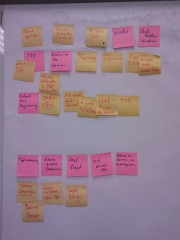
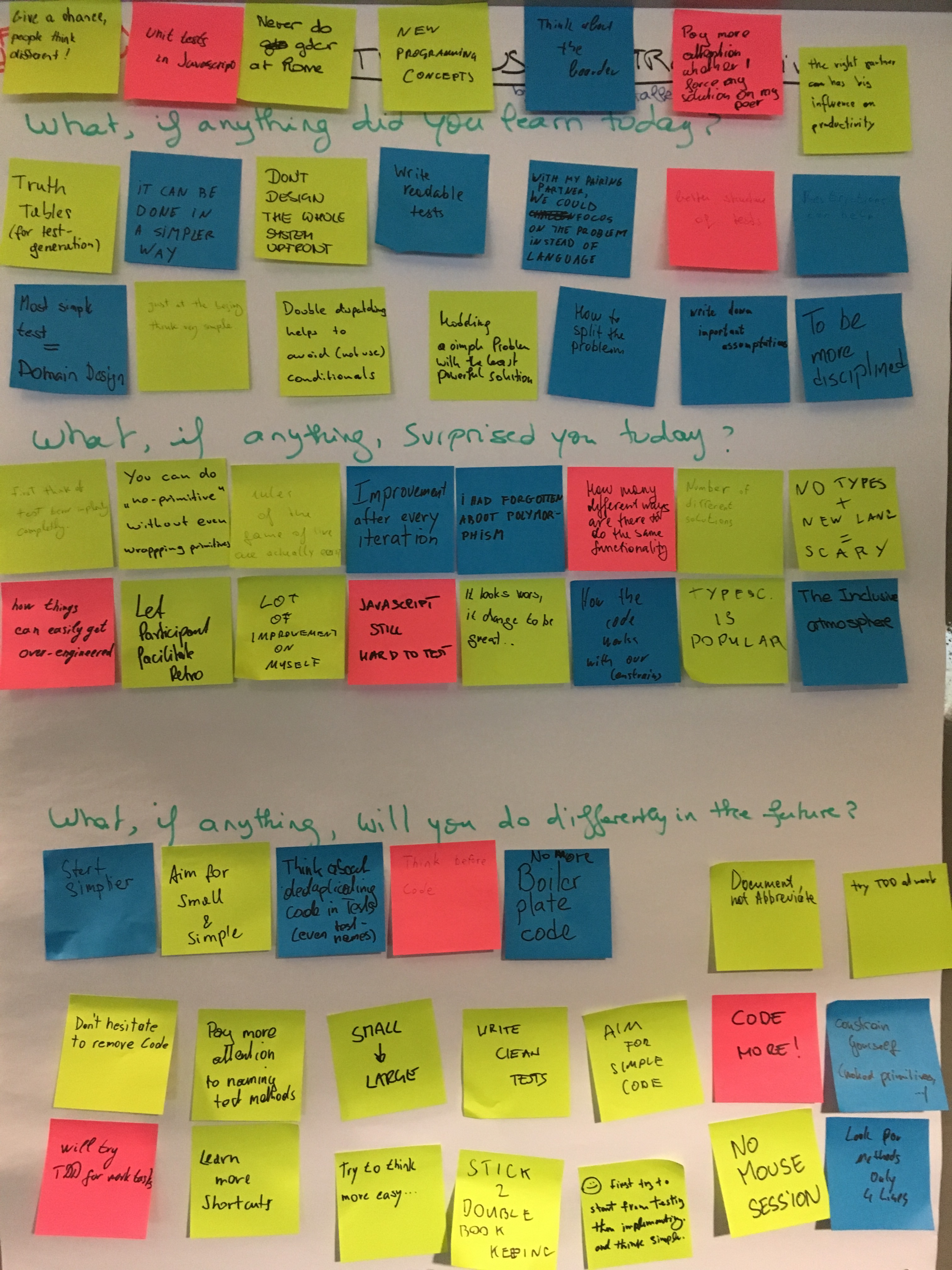 Some of you learned "new programming concepts" and that "it can be done in a simpler way". (These quotes were things you wrote on the Post-its on the picture on the right.) Others found new ways "how to split the problem". Several people discovered that pair programming was productive. You were surprised that there were so "many different ways to do the same functionality". But most important you decided to do things differently in the future. Here are some things that you wanted to do:
- "Try TDD at work!"
- "Learn more shortcuts!"
- "Aim for simpler code!"
- "Code more!"
A box of things to take from the Coderetreat
At the end of the Coderetreat the facilitators, Houssam and I, talked about things you might want to try after the event. Houssam called it the "Box of things to take home".
- Code Katas. Code Katas are exercises like the Game of Life. You can find many suitable exercises at codingdojo.org or codekata.com. If you like to crack some math problems I recommend Project Euler. It is a lot of fun!
- Coding Dojo. A Coding Dojo is an event like a Coderetreat, just shorter. In Vienna there is the Coding Dojo Vienna. If you need for more practise this is the place to go. The dojo happens once a month. To get notified about upcoming events register at Softwerkskammer Gruppe Wien or follow #CodingDojoVie on Twitter. More information about Coding Dojo can be found in Emily Bache's excellent book.
- Pair Programming. You can run your own practise session in a coffee shop or McDonalds. Talk to people in your company or at local meetups and find some like minded individuals.
- Screencasts. Recordings of Code Katas, sometimes called Katacasts, are a great source for learning. This way you can (kind of) pair program with famous people like Robert C. Martin, J.B. Rainsberger, Sandro Mancuso and others.
- For more details on how to improve your skills further, I recommend Houssam's (and Boris Gonnot's) article How to Boost Your Skills to Become a Better Developer.
Finally I want to point you to the Software Craftsmanship community in general. In Germany, Austria and Switzerland the local Craftsmanship communities are hosted by the Softwerkskammer. There is a group for Vienna and Linz. These communities run yearly conferences, the SoCraTes (Software Craftsmanship and Testing) unconferences. Currently we have SoCraTes conferences in many countries. In Austria the next SoCraTes will be autumn 2017 in Linz.
I wish you all the best for your future. You can do it!


 Quality important is. Fight for it you must ;-)
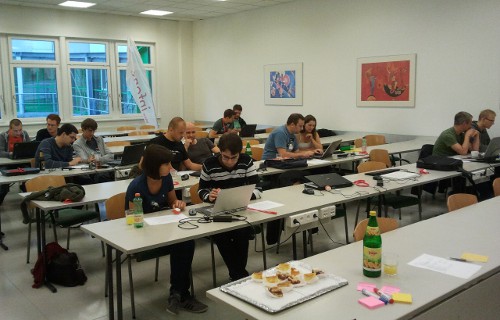 After morning coffee I
 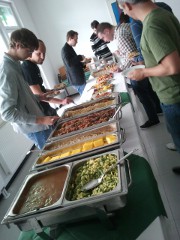 During the first session almost all teams used arrays of integers or boolean flags so I chose No Naked Primitives as constraint for the second session. During that session only one pair worked on the business rules and all others created only infrastructure, so I proposed to focus on the domain in the next session. Lunch was great, we had wine and beer, several main dishes, even cheese and sweets. It was luxuriant - thank you
  It was a very nice Code Retreat. The 15 participants were a good mixture of junior and senior developers, Scrum Masters and even one Product Owner who wanted to know what "his" developers do in their personal time ;-) People learned a lot, many of them had their first contact with TDD and pair programming in practice. Several decided to give TDD a try in their daily work. Thanks to our awesome sponsors INFONOVA and Campus02 we had everything we needed and the attending developers used the opportunity and made it a great event. Thank you all!
 Markus used a gigantic spreadsheet to enter all parameters needed for such a calculation. It contained roughly 200 input parameters and 500 metrics for up to 50 product parts resulting in huge files with thousand of lines. Obviously Excel was reaching its limits and he needed something more powerful. We spent the first day discussing the domain of carbon footprint and created a small diagram defining the core elements of his calculations. Although we did not write any code it was a productive day because I helped Markus to reflect on his needs and he explained the requirement to me at the same time. We came to the shared conclusion that he needed a real database, but one that he might be able to develop himself, so we ended with Visual Basic (for Applications aka VBA) and MS Access. Although I did not fancy VBA it was the best choice for his needs and he liked the idea that he would be able to use parts of our VBA code in his spreadsheets as well.
 Culture Shock