6 August 2012

Code Cop Kofler

Summer began last month in Austria and I went abroad and got myself a lovely souvenir: a carved wooden desk name plate. I was not sure what to write there and thought about my twitter name but did not trust the artificer to cope with the @-sign and ended with some kind of hybrid name:

Code Cop Kofler
In hindsight I was clever not to ask for something complicated because the guy messed it up twofold and did not even get the letters of my name right. Nevertheless it is an icon of my office and I love it. If only I had a desk to put it on.

My Open Source Involvement

My current employer is refreshingly serious about software licenses. For example if an open source library is GPL licensed, it just cannot be used in a product or service offering. End of story. All other companies, I have ever worked for, just did not care. I like being serious about software. But it is not just about using the software, in fact it is about being contaminated with someone else's intellectual property, whatever this might be. To comply with my employer's bureaucracy I have to report my open source involvement and get written permission from my manager. Ok, so let's collect all my active open source projects and list them here as well. Some advertising never hurts.

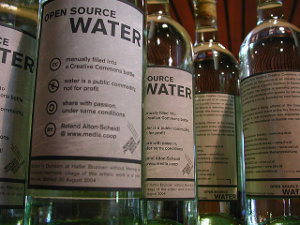
Open Source Water Bottles
  • It began with PMD (BSD License), a source code analyser for Java, which I used a lot. In 2004 I started submitting patches and later I created my own set of custom rules as Maven module. Unfortunately the new PMD 5.0 is not backward compatible, so I have some pending work to do here. (Source Code)

  • In 2008 I created a system tray notifier to monitor build servers under BSD license. I use it myself and have to create maintenance releases from time to time. (Ah delicious dog food ;-)

  • javaclass-rb is a Java class file parser in Ruby. I created it in 2009 and I there is a small release once a year. Although it is not finished, it is particularly useful to analyse custom Java code. I hope that I will have some time in the future to describe it in detail.

  • Since last year I am organizing Hackergarten Vienna. Hackergarten is a craftsman's workshop, a classroom, a laboratory, a social circle, a writing group, a playground and an artist's studio. We meet once a month and work on Open Source. During this time I have submitted patches with working code to Commons Exec, Castor, Commons Email and JMeter (all under Apache License).

  • My latest project is BaDaDam, an experimental BDD framework for Java. It allows you to write stories in plain text, implement them in Java classes and just run them using JUnit. Some people from Hackergarten have helped me with contributions.

  • Occasionally I submit pieces of code to Rosetta Code, a programming chrestomathy site.

5 August 2012

T-shirt Update

D.R.Y. - don't repeat yourselfI love t-shirts and keep wearing them regardless of my employer's dress code. I had only two complaints about them in the last year, so things worked out quite well ;-) The last time I wrote about Code Cop t-shirts was more than two years ago, so it is definitely time for an update.

Don't Repeat Yourself
The Don't Repeat Yourself or DRY principle states that every piece of knowledge must have a single, unambiguous, authoritative representation within a system. In simple terms this means that there should be no duplicates or repetition. The dark blue DRY shirt reminds me to write things once and only once. It is also my best selling shirt ever, as a friend bought one after he was exposed to horrible duplicated code at the client's site. Unfortunately I did not get rich as I bought him a beer in return.

Green Bar Test RunnerKeep the bar green to keep the code clean
Keeping the bar green is the primary motto of JUnit, the popular unit-testing framework for Java. This grey shirt displays a simplified image of the Eclipse JUnit runner together with a green bar. I had problems finding the right dimensions for the characters and the green check marks and threw away at least three versions until I got it right. One day I wore it in the office and one of my colleagues, a project manager, asked me "green is good, right?" I just love them.

Red Green RefactorRed-Green-Refactor
Red-Green-Refactor is the cycle of Test Driven Development. You write a failing test which results in a red bar. Then you write some code until the bar is green. Finally you clean up the code you just wrote, e.g. improve the names or remove duplication. (Remember DRY?) For the white shirt I used typefaces according to these phases: Red is scary, I do not like it, so I used a Halloween typeface for it. Then I go for a green bar as fast as possible, so I used a dynamic typeface for that. My result after refactoring is sorted and tidy symbolized by a regular typeface.

(Buy Code Cop shirts)